
Artificial Intelligence
Personality analysis with AI: how it works
Personality analysis with AI is the application of artificial intelligence to estimating a person's psychological traits from their written language: how they express themselves, which words they choose, how frequently they use certain grammatical forms. It is one of the most fascinating areas of AI because it brings together two seemingly distant worlds, computational linguistics and psychology, and opens up concrete scenarios for customer experience, sales and personalized communication.
The topic is particularly close to Athics, because it is the foundation of Portrait technology, which profiles personality and communication style in real time by analyzing the way people write. In this guide we look at how AI manages to read personality in language, which psychometric models it uses, what the most mature use cases are and which ethical and privacy considerations cannot be ignored.
How does AI analyze personality?
Artificial intelligence does not "intuit" personality the way a human would: it infers it from statistical regularities in language. Decades of psycholinguistic research have shown that the way a person writes, even more than what they write, contains stable signals about how they think and relate to others. So-called function words (articles, pronouns, prepositions, conjunctions) are particularly revealing: they go unnoticed by the reader, yet their frequency of use correlates with personality traits, emotional states and relational styles.
A personality analysis system with AI therefore processes large amounts of text and looks for these regularities. The most recent models, based on large language models, can estimate psychological traits even without task-specific training, leveraging the linguistic knowledge acquired during general training. This is an important shift: it means psychometric profiling can happen continuously, on real conversations, without asking the user to fill in questionnaires.
To frame the phenomenon more clearly it helps to distinguish three levels of analysis:
- Lexical level: which words and semantic categories appear most often (emotion, certainty, sociability).
- Stylistic level: the use of function words, sentence length, syntactic complexity.
- Pragmatic level: tone, communicative intent and the way the person addresses the other party.
Combining these signals makes it possible to build a profile that is not a clinical diagnosis, but a probabilistic map that helps us better understand who we are dealing with and adapt our communication accordingly.
The Big Five model as a reference
When we talk about personality traits, the most solid framework is the Big Five model, recognized by the scientific community (including the American Psychological Association) as one of the most validated. The five traits are openness to experience, conscientiousness, extraversion, agreeableness and emotional stability. Each trait represents a spectrum along which each of us is positioned, and it is exactly this gradient that makes it suitable for automated analysis.
AI maps recurring linguistic patterns to each of these traits. A person high in extraversion, for example, tends to use more social and positive language; someone highly conscientious often shows more structure and attention to detail. These are not rigid correspondences, but statistical tendencies that, given a sufficient volume of text, become informative. This approach helps overcome the limits of traditional self-administered tests, which are often influenced by social desirability and can rarely be repeated frequently.
Personality Analysis with AI: the potential of ChatGPT 4
Growing academic attention toward this area is reflected in a study published in Frontiers in Artificial Intelligence entitled “On the emergent capabilities of ChatGPT 4 to estimate personality traits”, which investigated precisely the ability of generative models to estimate personality traits through the analysis of written language, highlighting their potential and limitations based on the Big Five model.
The study, conducted by the Department of Industrial, Information and Bioengineering Engineering of the University of Pavia and the Department of Psychology of the Catholic University of the Sacred Heart in Milan, analyzed the ability of ChatGPT 4 to predict personality traits through a zero-shot approach, that is, without specific training on this task. Using two datasets of written texts, the researchers compared the AI estimates with the authors' self-assessments. The results show a moderate correlation between the model's predictions and the actual psychological characteristics of individuals, suggesting that Large Language Models (LLM) could have a role in automated psychological analysis, albeit with some limitations.
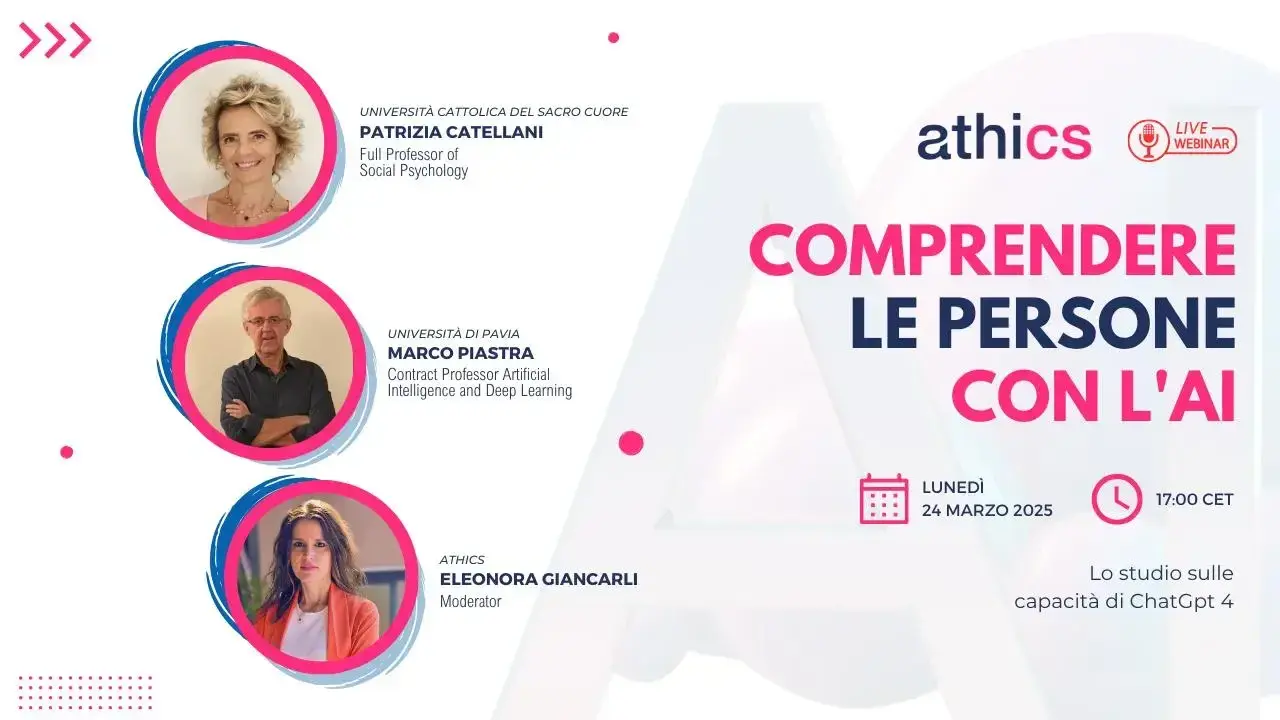
To present and discuss this research, Athics organized a webinar live on Linkedin on Monday 24 March at 5 pm, inviting Prof. Marco Piastra of the University of Pavia and Prof. Patrizia Catellani of the Catholic University of Milan. During the session, the starting scenario and the motivations behind the study, the expected results, the possible applications of personality analysis with AI, the future implications and the possible further developments of the research are examined.
What are the use cases of personality analysis with AI?
Understanding a person's psychological style in real time has enormous value in every context where the relationship matters. The principle is simple: the same message, phrased differently, can work with one person and fail with another. AI makes it possible to calibrate communication to the real person, not to an average recipient.
The most mature use cases today focus on three areas:
- Customer experience: adapting the tone, pace and content of replies to the customer's style, improving satisfaction and loyalty. It is a field we explore when discussing AI agents for customer experience.
- Sales: helping salespeople recognize a prospect's decision-making style, choosing the right arguments and timing to guide them toward a choice.
- Personalized communication: crafting messages, emails and content that truly resonate with the recipient, reducing the waste typical of standardized communication.
These scenarios do not replace human sensitivity, they amplify it: they give operators, salespeople and marketers an extra piece of information that is immediately usable. The difference compared with traditional analysis is scale and timeliness: what an expert might grasp only after many interactions, AI makes available from the very first exchanges.
The role of Athics Portrait
This is where Portrait comes in, the Athics psychometric profiling technology. Portrait analyzes a person's personality and communication style in real time from the text they produce, detecting over 80 traits through the study of the frequency of function words. The result is a dynamic profile that updates as the conversation progresses.
In practical terms, this means a conversational system or a human operator can receive guidance on how to adapt their approach: with someone who prefers concise, direct answers you get to the point, with someone seeking reassurance you devote more space to context. Portrait is designed to fit into a company's real processes, from customer care to sales, turning an already existing wealth of textual data into a personalization lever. It is a concrete example of how AI agents for business can gain a psychological dimension, going beyond simply understanding content.
Ethics and privacy: the indispensable considerations
Analyzing people's personality with AI is powerful, and precisely for this reason it must be approached responsibly. The first principle is transparency: anyone interacting with a system should know that their language may be analyzed and for what purpose. The second is proportionality: profiling must serve to improve the service offered to the person, not to manipulate or discriminate against them.
On the regulatory side, in Europe the reference is the GDPR, which requires clear legal bases for processing data, minimization, purpose limitation and the user's right to understand the logic of automated decisions. Added to this are governance good practices such as human oversight of significant decisions and retaining only the data that is necessary. We addressed these topics more broadly in our dedicated article on ethics and artificial intelligence, because we believe trust is the precondition for any lasting adoption.
It is also worth remembering an intrinsic limit, well highlighted by scientific research too: trait estimation is probabilistic, not an absolute truth. Treating a profile as a definitive label would be a methodological and ethical mistake. The correct use is that of a support that guides the relationship, always subject to human judgment.
Conclusion
Personality analysis with AI is moving from academic research to concrete business application, where understanding people's communication style makes the difference in customer experience, sales and personalized communication. The key is to use this capability with method and ethics, valuing people instead of reducing them to a label.
If you want to understand how psychometric profiling with Portrait can improve the relationship with your customers, talk to our team: we will help you identify the right use case and bring it into production.
Frequently asked questions
What is personality analysis with AI?
Personality analysis with AI is the use of artificial intelligence models to estimate a person's psychological traits from their written language. It often relies on psychometric models such as the Big Five and detects stylistic signals, like the frequency of function words, to reconstruct personality and communication style.
Which psychological models does AI use to analyze personality?
The most widely used reference is the Big Five model (openness, conscientiousness, extraversion, agreeableness, emotional stability). AI maps linguistic patterns to these traits, enabling estimates even with zero-shot approaches, without task-specific training.
How does Athics Portrait work?
Portrait is the Athics psychometric profiling technology that detects over 80 traits in real time by analyzing the frequency of function words in a written text. It returns a personality and communication-style profile that helps personalize the relationship with the customer.
Does personality analysis with AI respect privacy?
It depends on how it is designed. A sound adoption requires transparency toward the user, defined purposes, data minimization and human oversight of significant decisions, in line with the GDPR and responsible-AI principles.
Related articles

AI Digital Evolution: the future of business driven by data
Athics and DWIT explain how to implement an AI Digital Evolution strategy supported by Conversational AI: data, people and technology as growth drivers.

AI in the Food Industry: a new webinar Athics
A new Athics webinar explores the impact of AI in the food industry and presents the use case of Centrale del Latte di Torino.
AI for publishing: from information to education
AI for publishing is transforming information and training: discover CMI's Librarian Chatbot use case in the next Athics webinar, live streaming on LinkedIn.