
Artificial Intelligence
AI in the Food Industry: a new webinar Athics

How is AI in the food industry actually applied? Artificial intelligence in the food industry is the set of technologies - machine learning, language models, conversational assistants and predictive analytics - that food and beverage companies use to automate customer care, forecast demand, improve quality control and reduce waste. In this guide we look at where AI is already generating value in the food & beverage sector, which use cases are the most mature, and how a conversational solution can transform customer service, with the real-world example of Tapporosso, the chatbot supporting customer care at Centrale del Latte di Torino, built with the Athics Crafter.ai platform.
If PwC data suggests the AI market in the food industry will reach $43.4 billion by 2028, the question many companies are asking is no longer "if" to invest, but "how" to do so successfully. The answer lies in choosing the right processes to start with and in the ability to integrate artificial intelligence into systems that are already in use, without disrupting the organization.
What is AI in the food industry
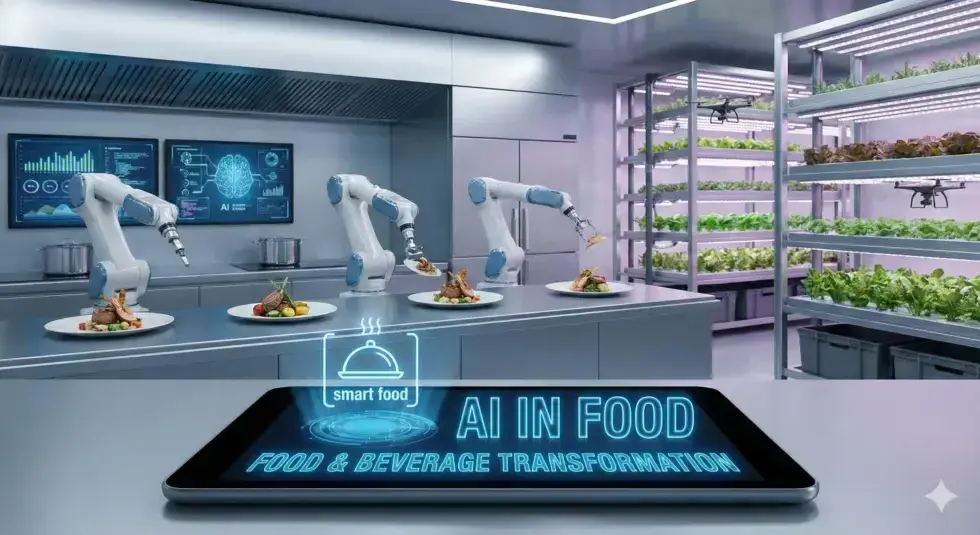
AI in the food industry refers to the application of artificial intelligence and machine learning across the entire agri-food and beverage supply chain: from production to logistics, from marketing to the direct relationship with the consumer. It is not a single technology but a set of tools that work on data to anticipate behavior, automate repetitive tasks and support decision-making. In a sector where quality, safety and timeliness are decisive competitive factors, artificial intelligence acts as an efficiency multiplier.
Companies in the food sector collect enormous amounts of information every day: orders, inventory, customer preferences, feedback, traceability data. For years much of this data went unused. AI makes it possible to turn it into operational knowledge, enabling accurate forecasts and targeted actions. This shift concerns both large industrial groups and small and medium-sized enterprises, which today can access technologies once reserved for multinationals thanks to accessible platforms and progressive adoption models.
How big is the AI market in food & beverage
According to a recent PwC survey, the market for AI applied to the food industry is expected to quintuple in value in the coming years. From $8.2 billion in 2023, estimates predict a jump to $43.4 billion by 2028, with a compound annual growth rate (CAGR) of 39.5%. These are figures that capture an acceleration hard to ignore for any company that wants to stay competitive.
North America currently leads the ranking, followed by Europe, but Italy is demonstrating surprising reactivity. In our country, 43% of food tech startups have already implemented AI and 37% use machine learning technologies, confirming that innovation is key to maintaining the competitiveness of a sector that accounts for 2.6% of national GDP. This momentum does not concern only new companies: long-established, deeply rooted businesses are also integrating artificial intelligence into their processes, often starting precisely from the point of contact with the consumer.
The market's growth is explained by a set of converging pressures: ever-higher customer expectations, the need to contain operating costs, and growing attention to sustainability and waste reduction. In this scenario AI is not a laboratory experiment but a concrete tool that delivers measurable results quickly. For a broader picture of artificial intelligence adoption in consumer-facing sectors, it is also worth looking at the dynamics of artificial intelligence in retail, where many of the personalization and automation patterns are already established and equally applicable to food.
How AI improves customer experience in food
AI in the food industry is redefining the direct relationship with consumers. In an increasingly competitive market, product quality is no longer enough: customers expect immediate responses, 24/7 support and an ongoing dialogue with their favorite brands. Companies that fail to respond in real time risk losing the relationship at the very moment of greatest attention, when the consumer has a question, a doubt or a concrete need.
Artificial intelligence allows F&B companies to transform customer service from a simple cost center into a powerful loyalty driver. Automating responses about promotions, ingredients, allergens or loyalty programs does not "cool" the relationship, but rather makes it more efficient and present, anticipating user needs. A well-designed conversational assistant recognizes the intent of a request, provides accurate information and, when necessary, hands the conversation over to a human operator, ensuring continuity and quality.
The benefits of an AI approach to customer experience in food can be summarized as follows:
- Continuous availability: 24/7 assistance with no drop in quality, even during request peaks driven by campaigns and promotions.
- Consistent answers: the assistant always applies the same sources and rules, reducing errors and contradictory information.
- Reduced operational load: recurring questions are handled autonomously, easing the pressure on phone and email.
- Consumer knowledge: conversation data tells the marketing team what real needs and most frequent requests are.
- Omnichannel reach: the same assistant can be present on website, app and social channels, keeping the experience consistent.
It is precisely within this context of customer experience innovation that the use case we explore below fits perfectly. To understand how virtual assistants evolve toward more autonomous and capable forms, it is also worth reading our piece on AI agents for customer experience, where the topic is addressed with concrete examples.
What are the main use cases of AI in the food sector
Artificial intelligence in food & beverage is not limited to customer service. The most mature applications span the entire value chain and address very different needs. Understanding them helps identify the right starting point for your own company, avoiding the dispersion of resources on low-priority projects.
Among the areas where AI is already delivering concrete results we find:
- Customer care and conversational assistance: chatbots and virtual assistants that handle requests about products, promotions and loyalty.
- Demand forecasting: predictive models that anticipate consumption and optimize inventory and production, reducing unsold stock.
- Food waste reduction: cross-referencing sales data, expiry dates and seasonality helps limit waste along the supply chain, a central theme for the FAO in the fight against food loss.
- Quality control and safety: sensor technology combined with machine learning monitors production processes and hygiene standards in real time.
- Marketing and personalization: analysis of purchasing behavior for targeted offers and more relevant communications.
The common thread is always the same: AI does not replace people's skills but enhances them, freeing up time from repetitive tasks and making available information that was previously hard to extract. This logic of intelligent automation is the same we find in AI agents for business, software capable not only of answering but of acting within business processes.
The Centrale del Latte di Torino use case and the Tapporosso chatbot
A concrete example of AI in the food industry is the project carried out by Centrale del Latte di Torino, which implemented an artificial intelligence solution to solve a challenge common to many businesses: managing the growing volume of repetitive requests about promotions, loyalty programs and events, which risked overloading traditional channels like telephone and email. A situation that, especially during promotional campaigns, can become hard to manage with human resources alone.
Tapporosso is the chatbot built with the Athics Crafter.ai platform. This project perfectly demonstrates how AI in the food industry can combine efficiency and customer satisfaction, bringing tangible results in terms of:
- Self Care Automation: the virtual assistant makes it easier for consumers to find information in self-care mode, with no waiting.
- Resource optimization: automatic management of frequently asked questions makes it possible to guarantee 24/7 assistance to consumers and to optimize customer service management.
- Analytics: access to conversation data allows the marketing team to identify frequent requests and capture consumer feedback and needs.
This use case was presented by Athics in a webinar dedicated to industry professionals, with the participation of Pierluigi Sandonnini, journalist and Senior Web Editor, and of Amalia Lumia and Ilaria Mainella, respectively Marketing Manager and Marketing Specialist at Centrale del Latte di Torino, who described first-hand the journey of adopting the Tapporosso chatbot. The value of examples like this lies in showing that artificial intelligence is not an abstract promise but a solution already in operation within Italian food companies.
How to adopt AI in your food company
Effective adoption of AI in the food industry starts from a measurable goal, not from the technology. It helps to pick a high-volume, low-complexity process - typically customer care - define the expected results and start with a pilot. No-code platforms for building virtual assistants and AI agents, like Athics' Crafter.ai, make it possible to go from idea to go-live in a few weeks, integrating the solution with the systems already in use and refining it based on real usage data.
The typical path involves a few clear steps: choosing the priority use case, integrating with company data sources and content, testing with real users, and going to production with continuous performance monitoring. It is an iterative approach that allows you to start in a controlled way and scale as results confirm the value of the solution. Companies that adopt this logic avoid the two most common mistakes: investing in technology without a clear goal, or postponing indefinitely while waiting for the perfect solution.
In conclusion, artificial intelligence in the food industry is no longer an option for a few pioneers, but a competitive lever accessible to every company in the food sector. From customer care to demand forecasting and waste reduction, the use cases are concrete and the results measurable, as demonstrated by the experience of Centrale del Latte di Torino with the Tapporosso chatbot. If you want to understand how AI can generate value in your processes and improve your consumers' experience, perhaps starting from an AI e-commerce chatbot, the first step is to talk with those who build these projects every day. Talk to the Athics team: we will help you identify the right use case and bring it into production.
Frequently asked questions
What is AI in the food industry?
AI in the food industry is the application of artificial intelligence, machine learning and conversational assistants to processes across the food and beverage sector: from customer care to demand forecasting, from quality control to waste reduction. The goal is a supply chain that is more efficient, safer and able to respond to consumers in real time.
How big is the AI market in the food sector?
According to a PwC survey, the market for AI applied to the food industry was worth $8.2 billion in 2023 and could reach $43.4 billion by 2028, with a compound annual growth rate (CAGR) of 39.5%.
How is an AI chatbot used in food & beverage customer experience?
An AI chatbot autonomously handles recurring questions about promotions, ingredients, loyalty programs and events, provides 24/7 assistance and gives the marketing team conversation data to understand consumer needs. This is exactly what Tapporosso does, the chatbot built for Centrale del Latte di Torino with the Athics Crafter.ai platform.
Can AI help reduce food waste?
Yes. Predictive algorithms anticipate demand and optimize inventory and production, reducing unsold stock and waste along the supply chain. Sensor technology combined with machine learning also helps monitor food quality and safety in real time.
Related articles

Conversational AI in customer service: less friction, more value
Conversational AI in customer service: use cases, Gartner data and the Claxon.ai voice agent for automotive from the Athics webinar with Add Value and Adawen.

AI Digital Evolution: the future of business driven by data
Athics and DWIT explain how to implement an AI Digital Evolution strategy supported by Conversational AI: data, people and technology as growth drivers.

AI for publishing: from information to education
AI for publishing is transforming information and training: discover CMI's Librarian Chatbot use case in the next Athics webinar, live streaming on LinkedIn.