
News
Artificial Intelligence in Retail

Artificial intelligence in retail is the set of technologies that analyze sales data, buying behavior and stock availability to personalize the customer experience, automate support and make operations more efficient, both online and in the physical store. In just a few years it has moved from a futuristic promise to a concrete growth lever: today the question is no longer "whether" to adopt it, but how to use it to improve the customer experience and margins.
This was also the focus of our webinar with Daniele Cazzani, retail expert and founder of newmarketingretail.com, in which we explored how AI is influencing the shopping experience, customer expectations and business strategies. In this guide we gather and expand on that content to offer a complete, up-to-date picture.
Why artificial intelligence in retail is now a certainty
To grasp the scale of the change, during the webinar Daniele Cazzani introduced the concepts of VUCA (Volatile, Uncertain, Complex and Ambiguous) and BANI (Brittle, Anxious, Non-linear and Incomprehensible). These two acronyms capture the challenges and uncertainty the sector is going through: the shift toward digitalization, accelerated by the pandemic, and the deep changes in consumer behavior have rewritten the rules of the game.
The central point is that customer expectations have changed irreversibly. Shoppers today expect a frictionless experience, like the one they get with e-commerce, even when they walk into a physical store. They want to find the right product quickly, get immediate answers and feel continuity across channels. This pressure has forced many companies to revise their strategies and to view artificial intelligence in retail not as an experiment, but as an enabling infrastructure.
In such an unstable context, AI offers retailers three advantages that are hard to ignore:
- Forecasting power: anticipating demand and adjusting the assortment before the market shifts.
- Personalization at scale: treating every customer as an individual even across millions of transactions.
- Operational responsiveness: reacting in real time to requests, peaks and unexpected events without overloading teams.
How generative AI is changing the retail trade
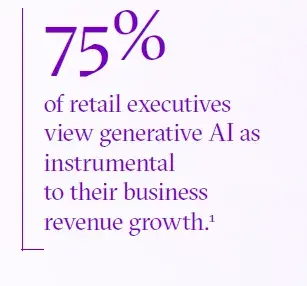
The spread of large language models has opened a new phase. In Accenture's report “Retail Reinvented: Unleashing the Power of Generative AI”, 75% of retail managers consider generative AI essential for business growth. This figure captures a shift in mindset: the debate is no longer about the opportunity to invest, but about how to define clear goals and understand where artificial intelligence can really move the needle.
As Daniele explained, generative AI can directly support customer service by improving efficiency, providing targeted, personalized suggestions and enhancing user satisfaction in real time. The difference from the past is the naturalness of the interaction: the customer no longer has to adapt to rigid menus or forms, but converses in natural language as they would with an expert shop assistant. This profoundly changes the way people search for, compare and choose products.
The impact of generative AI on the retail trade shows up on several fronts at once. On the customer side, it enables intelligent conversations and more precise searches; on the company side, it cuts repetitive work in creating content, catalog descriptions and standard replies. It is no surprise that the first area of application is often the customer relationship, where a well-designed AI e-commerce chatbot can handle thousands of conversations while keeping brand consistency and tone.
What are the main use cases of AI in retail?
Artificial intelligence in retail is not a single technology, but a range of applications that touch every stage of the shopping journey. Some are already mature and adopted at scale, others are emerging thanks to generative AI and autonomous agents. What they have in common is the ability to turn data that companies already own into concrete decisions and actions.
Among the most relevant use cases for those working in the retail trade are:
- Automated customer support: handling pre- and post-sale requests, multilingual support, order tracking and resolution of recurring problems with no waiting times.
- Personalized recommendations: engines that suggest products consistent with each customer's history and preferences, increasing average basket value and conversion rate.
- Inventory and demand management: more accurate forecasts to reduce stockouts and excess inventory.
- Dynamic pricing: adjusting prices according to demand, seasonality and competitive behavior.
- Purchase behavior analysis: reading sales data to guide marketing, store layout and promotional campaigns.
These areas do not live in silos. They are increasingly coordinated by AI agents for business that not only answer questions but perform concrete actions: updating an order, checking item availability, starting a return procedure. It is the shift from an AI that "suggests" to an AI that "executes", with a direct impact on operational efficiency.
AI as a shopping influencer and the role of transparency
A tangible example of how AI is revolutionizing the shopping experience comes from Google, which has developed a natural-language chatbot capable of suggesting dinner menus and responding flexibly to user requests. This technology is groundbreaking: consumers are increasingly open to this type of interaction, because AI meets the growing demand for simplicity and guidance in an ever wider and more complex array of choices. In practice, artificial intelligence becomes a kind of shopping advisor available at any moment, able to filter out the noise and steer the customer toward the most suitable solution.
However, as Daniele emphasized, the effectiveness of these tools cannot come at the expense of transparency. Consumers need to know they are interacting with an artificial intelligence: only this way is a relationship of trust built and a high standard of transparency and ethics maintained. An assistant that pretends to be human breeds distrust the moment the deception is discovered, while an assistant that is openly AI-based, yet useful and accurate, reinforces the brand's perceived reliability. In retail, trust is an asset that is built over time and lost in an instant.
How to bring online and offline together with an omnichannel experience?
Another central theme that emerged in the webinar is the convergence between e-commerce and physical retail. Consumers no longer differentiate between the two channels: they expect a seamless, integrated experience, where they can start a purchase on their phone, complete it in store and receive support via chat, without repeating information or losing the thread. Artificial intelligence is the glue that holds these touchpoints together, recomposing data from different channels into a single view.
The digital tools that enable this omnichannel experience are by now part of the modern retail landscape:
- Interactive kiosks that let customers browse the full catalog, well beyond what is physically on display.
- Self-checkouts that cut queues and give customers back control of their time.
- The “endless aisle” that bridges the gap between store and digital warehouse, offering products and information beyond those available on the physical shelf.
The value of these tools lies not in the technology itself, but in the continuity they create. A customer who receives consistent recommendations online and in store, who does not have to explain the same problem twice and who perceives personalized attention, develops a stronger bond with the brand. The same logic of intelligent support and personalization applies to adjacent sectors: we discussed it, for example, in relation to AI in the food industry, where customer experience and operational management are intertwined in the same way.
Market figures and outlook
Interest in artificial intelligence in retail is also confirmed by market data. Beyond the 75% of managers cited by Accenture, the leading analyst firms agree on a trajectory of rapid growth. According to McKinsey, generative AI could generate trillions of dollars in annual value globally, with a significant share precisely in the marketing, sales and customer care functions that are at the heart of every retailer's activity. Analysts such as Gartner have long highlighted how AI is becoming a structural component of enterprise software, and the retail trade is one of the sectors where this transition is most clearly visible.
These figures explain why so many companies have already moved AI from the lab to production. These are no longer isolated experiments, but projects that affect revenue, costs and loyalty. Competitive advantage increasingly depends on how quickly a retailer can turn its own data into better experiences for the customer.
How to get started with AI in retail
Artificial intelligence in retail represents an extraordinary opportunity to enhance the customer experience and increase operational efficiency, but the starting point is not technology: it is self-analysis. Companies need to question their own goals and assess whether they have the data necessary to fully leverage AI's potential. A project that starts from a clear question — reducing response times, increasing conversions, cutting stockouts — has a far better chance of success than one that starts from the tool of the moment.
The typical adoption path unfolds in a few concrete steps: choosing a high-volume, low-complexity use case, checking the quality and availability of data, launching a pilot with real users and then going to production with continuous performance monitoring. No-code platforms for building AI solutions, like the ones Athics works on with Crafter.ai, make it possible to go from idea to go-live in a few weeks, integrating AI with the systems already in use and refining it based on real usage data. To dig deeper into how AI changes the customer relationship, our piece on AI for customer experience is also worth reading.
Conclusions
Artificial intelligence in retail is no longer a futuristic vision, but an innovation engine that is already operational: from technologies that optimize customer support to omnichannel solutions that improve the customer journey at every touchpoint. With a strategic, customer-focused approach that is mindful of transparency, AI becomes a decisive tool for the future of the retail trade, able to sustain growth and strengthen the bond between consumers and brands.
If you want to understand how artificial intelligence can create concrete value in your retail and e-commerce processes, talk to our team: we will help you identify the right use case and bring it into production.
Frequently asked questions
What is artificial intelligence in retail?
Artificial intelligence in retail is the set of technologies that analyze sales data, customer behavior and inventory to personalize the shopping experience, automate support and optimize pricing and stock. It moves retailers from gut-feel decisions to data-driven ones, both online and in physical stores.
How is generative AI used in retail?
Generative AI in retail powers conversational shopping assistants that recommend products, auto-generated catalog descriptions, natural-language search and after-sales support. According to Accenture, 75% of retail managers consider it essential for business growth.
What are the main use cases of AI in retail?
The most common use cases are automated customer support, personalized recommendations, inventory and demand management, dynamic pricing, omnichannel experiences such as the endless aisle, and analysis of purchase data for marketing.
Will artificial intelligence replace physical stores?
No. AI does not replace the store, it strengthens it. Tools such as interactive kiosks, self-checkouts and the endless aisle bridge online and offline, while staff focus on advice and customer relationships, where the human contribution makes the difference.
Where should retailers start with AI?
Start from a measurable goal and a high-volume use case, check the quality of the available data and launch a pilot project. No-code platforms make it possible to go from idea to production in a few weeks, integrating AI with systems already in use.
Related articles

AI projects into digital execution: Athics–DWIT
The partnership between Athics and DWIT combines cognitive science and system integration to turn Artificial Intelligence projects into digital execution.

HR onboarding chatbot: the Humanitas case with Athics
Humanitas Research Hospital has chosen Athics to develop its HR onboarding chatbot to support new hires' onboarding process.

AI journalism: how news production is changing
AI Journalism is a new way of producing news with AI, transforming the journalist's role between automation, source verification, risks and opportunities.