
Artificial Intelligence
Conversational AI in customer service: less friction, more value

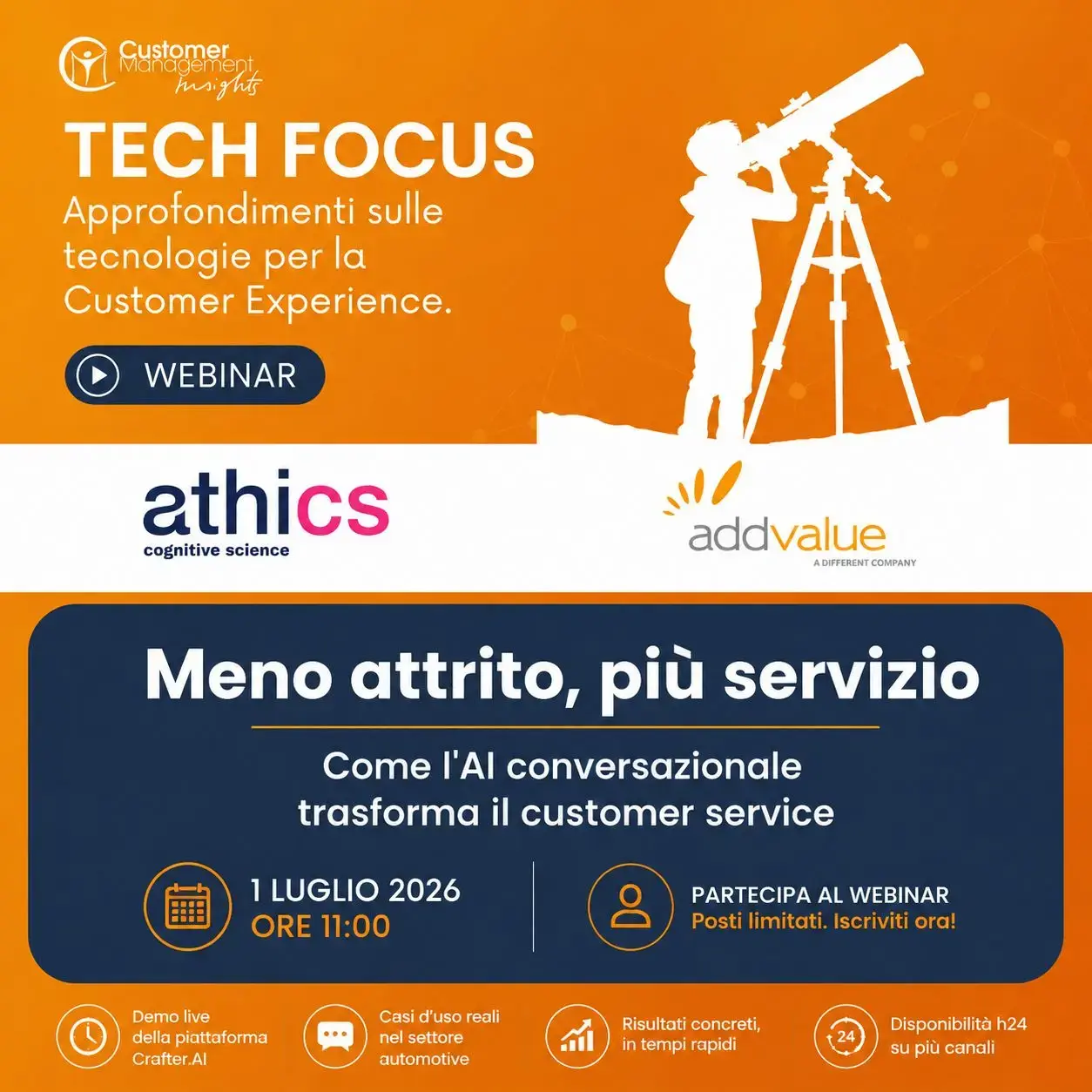
Conversational AI in customer service is no longer an experiment: it is a mature technology, accessible to SMEs as well, that turns customer support from a cost center into a value generator. That was the core message of the webinar "Less friction, more service" organized with CMI Magazine, where Paolo Massarani, Managing Director of Athics, Giandomenico Biondaro of Add Value and Enrico Perazzolo of Adawen explained how to build concrete artificial intelligence projects for customer support, starting from the data companies already have.
Between a constant stream of technology announcements, fear of missing out and doubts about real usefulness, many companies swing between FOMO and paralysis. The webinar proposed a pragmatic path: start from the basics, pick simple high-volume use cases, measure results and scale. In this article we walk through the key points of the session, the demo of the Claxon.ai voice agent for automotive dealers, and the partnership model that made the solution possible.
Why is conversational AI in customer service a mature technology?
The relationship with customers is the beating heart of every organization: support, relationship, care. And this is exactly where conversational artificial intelligence stopped being an experiment a long time ago. According to Gartner, by 2029 agentic AI will autonomously resolve 80% of common customer service issues, leading to a 30% reduction in operational costs. And according to IDC FutureScape predictions on agentic AI, by 2027 half of enterprises will be using AI agents to redefine how humans and machines collaborate, and agentic systems are projected to account for nearly half of all AI spending by 2029. We are not talking about niche applications, but about projects that already have a measurable impact on operations costs. The difference from "futuristic" AI projects — complex, expensive, with long timelines and a real risk of failure — is that in customer service the technology is consolidated and the path is already mapped out. For businesses built mostly on small and medium-sized enterprises, what matters is concreteness and risk reduction: a very big step forward with a relatively small effort.
Where to start? Simple use cases, high volumes and ready-to-use data
The recipe proposed by Paolo Massarani is deliberately simple: start from the basics, without flights of fancy. The advice Athics gives to customers and partners is to begin with well-scoped projects, test in the field, build confidence with the technology and plan a scalable path towards integration with all internal systems from day one.
Customer care is the ideal starting point because it combines all the favorable conditions:
- Data already available: existing FAQs, databases, CRMs and knowledge bases can be structured with minimal effort and immediately become usable by large language models.
- High volumes: volumes are where the investment pays back quickly, with benefits visible in a very short time.
- Peak management: the AI agent absorbs request peaks with no impact on staffing and no extra cost.
- Instant multilingual support: for exporting companies, support in multiple languages is almost automatic.
The most requested use cases today involve voice, which is growing fast: handling phone calls, supporting human operators and assisting on internal systems. All of this is made possible by deep integration with company systems through protocols such as the Model Context Protocol (MCP) and APIs. If you want to dig deeper into how these agents work, we have a dedicated guide on AI agents for business and an article on AI agents for customer experience.
Claxon.ai: the voice agent for automotive dealers
The heart of the webinar was the real-world case: Claxon.ai, the conversational AI solution for automotive dealers developed by Add Value and Adawen — the group division that has specialized in the automotive sector for over thirty years — on Athics' Crafter.ai platform.
The demo: booking a car service with a voice assistant
In the scenario shown during the webinar, the voice assistant of a fictional dealership autonomously handles the booking of a routine service appointment at the workshop. The conversation covers every critical step of a real service:
- The customer calls and asks to book a service appointment.
- The assistant asks for consent to process personal data, in compliance with the GDPR.
- From the license plate it retrieves the vehicle model and the associated email, asking the customer to confirm.
- It checks the available workshop slots, proposes the times and confirms the appointment by email.
- It answers a question about the warranty extension by drawing on the knowledge base.
- When the customer asks for an operator, it transfers the call to a human, displaying the full conversation history on screen.
The smooth handover between AI agent and operator is one of the distinctive points: artificial intelligence and human beings do not travel on separate tracks, they pass the ball to each other like a single team. And the solution is fully omnichannel: the same experience applies to web, voice and social media.
Which problems does it solve for dealerships?
Claxon.ai was born from listening to dealers' everyday problems: excessive traffic overloading the contact center with repetitive activities such as service bookings and tire changes, slow or inconsistent answers, no coverage outside business hours, little visibility on performance and volumes. The result is lost requests, dissatisfied customers and staff busy with low-value activities. Beyond appointment booking in the service department, the platform covers sales use cases (requests about vehicles listed on the website, test drive bookings), proactive outbound campaigns integrated with social channels and the CRM, and even the construction of the company knowledge base: the knowledge of an individual workshop technician, which would risk being lost if that person left the company, is transferred to the system through a simple conversation with the AI.
Governance, KPIs and continuous improvement
One aspect the speakers insisted on is that a serious conversational AI solution is not a chatbot bolted onto external systems, but a complete platform: integration layers that connect to the customer's systems without constraints, GDPR compliance, and architectural-level handling of the critical aspects of AI, such as hallucinations and out-of-context answers. Governance includes monitoring KPIs and full traceability of conversations: completion rate, conversion into appointments, missed calls, answer quality. The initial setup is done hand in hand with the customer, then the work shifts to continuous improvement. Not just automation, therefore, but control and constant optimization. The final benefits: fewer manually handled calls, 24/7 availability, a better customer experience and a team free to focus on strategic activities. In short: less operational stress, more added value.
A replicable partnership: platform plus vertical expertise
The last part of the webinar told the story of the collaboration between Athics and the Add Value group, born from a real need on a conversational AI project between late 2022 and early 2023. Two software houses that, instead of competing, chose complementarity: Athics brings the Crafter.ai platform and ten years of expertise in conversational artificial intelligence; Add Value brings vertical knowledge of business processes, system integration and data governance. That last point is far from secondary: as recalled in the webinar, Gartner estimates that 60% of AI projects will be abandoned precisely because of the lack of AI-ready data. Knowing who brings which value to the relationship is what allows the benefit to reach the customer all the way. It is the same principle driving Athics' other collaborations, such as the partnership with DWIT for digital execution.
The rules that made the partnership work can be replicated in any industry:
- Transparency: clear roles, responsibilities, costs and timelines from the very beginning.
- Pragmatic approach: prove it in the field with a first real case, even before the contract.
- Fusion team: an extended team that talks every day on a shared platform and methodology.
- Management buy-in: the strategic choice to collaborate must come from the top, with a "collaboration versus competition" mindset.
The target is explicit: the mid-market — in Italy, SMEs. Companies that do not have huge structures or highly specialized internal skills, and that find a safe harbor in the platform and in the partners: a clear privacy model, costs known in advance with no surprises, the option to start small and scale, and a direct, local relationship.
From friction to service: customer service as a value generator
The closing message of the webinar is clear: conversational AI in customer service is a train companies cannot afford to miss, but it must be boarded with method. Simple use cases, high volumes, ready data, measurable KPIs and a scalable path: this is how customer support stops being a cost to squeeze and becomes an engine of value and loyalty.
You can watch the full webinar on demand on the CMI Network platform (the session is in Italian). And if you want to understand how to apply these principles to your company, explore our AI for customer care solutions or contact us: we can build a personalized demo on your data, with no commitment.
Frequently asked questions
What is conversational AI in customer service?
It is the use of agents based on large language models that talk with customers in natural language — over the phone, in chat or on social media — to answer questions, complete operations such as a booking, and hand the conversation over to a human operator when needed.
Which use cases should a company start with?
Start with simple, high-volume use cases where data is already available: FAQs, appointment bookings, order status requests. High volumes and ready-to-use data mean a fast return on investment and lower risk.
What is Claxon.ai?
Claxon.ai is the omnichannel conversational AI solution for automotive dealers developed by Add Value and Adawen on Athics' Crafter.ai platform. It autonomously handles phone calls, service appointment bookings and customer requests, with a smooth handover to human operators.
Does conversational AI replace human operators?
No. It automates repetitive, high-volume requests while people focus on higher-value activities. Human operator and AI agent work as a single team: the AI can transfer the call to a human at any moment, with the full conversation history displayed on screen.
Related articles

AI Digital Evolution: the future of business driven by data
Athics and DWIT explain how to implement an AI Digital Evolution strategy supported by Conversational AI: data, people and technology as growth drivers.

AI in the Food Industry: a new webinar Athics
A new Athics webinar explores the impact of AI in the food industry and presents the use case of Centrale del Latte di Torino.

AI for publishing: from information to education
AI for publishing is transforming information and training: discover CMI's Librarian Chatbot use case in the next Athics webinar, live streaming on LinkedIn.