
Artificial Intelligence
AI for IT Help Desk: the Bestway case study
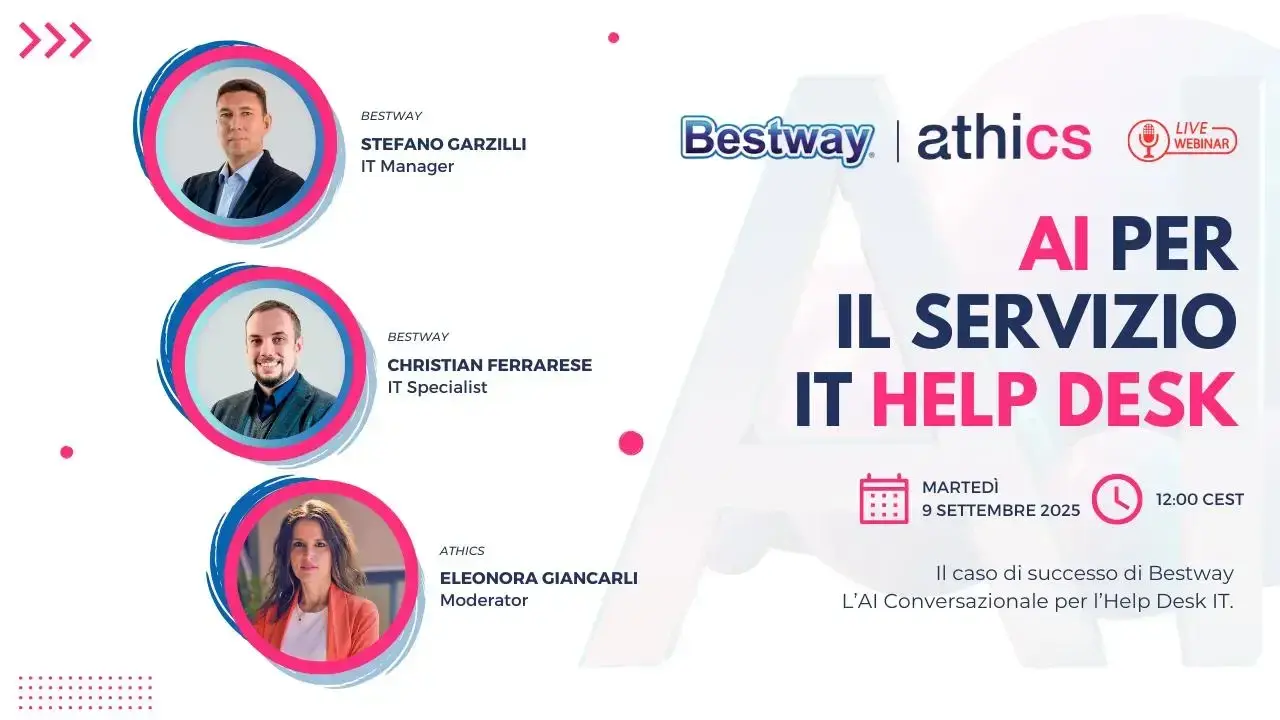
AI for IT help desk is the technology that automates internal technical support through conversational virtual assistants: an employee asks for help in natural language and gets an immediate answer, or sees their request resolved without opening a ticket or waiting for an operator. Password resets, network configuration, VPN requests and recurring questions about company policies are handled autonomously, while more complex cases reach technicians already enriched with all the context they need.
In recent years, the role of the IT Help Desk has undergone a profound transformation: from a purely reactive function to a strategic hub for internal innovation. Today the IT function must ensure efficiency, operational continuity and a rapid response to all business requests, often with lean teams and growing volumes. In this guide we look at what artificial intelligence can concretely do for technical support, the results it delivers on ticketing, self-service and deflection, and how the company Bestway adopted it with the Crafter.ai platform.
What AI for IT help desk means
Talking about artificial intelligence applied to technical support means equipping the help desk with conversational assistants able to understand employees' requests, draw on the company knowledge base and, where possible, resolve the issue without human intervention. These are no longer the old rule-based chatbots limited to predefined flows, but agents that interpret context, converse in natural language and integrate with the systems already in use.
According to a Gartner analysis, by 2026, 70% of companies that adopt AI in IT Service Management (ITSM) will achieve a significant increase in the productivity of their IT teams. Already today, over 60% of enterprise companies have begun investing in chatbots, virtual assistants and conversational automation for high-volume, low-value-added tasks, including:
- password resets
- network and device configuration
- VPN access requests and management
- first-level technical support
The point is not to remove the technicians' work, but to reduce the background noise that pulls them away from the activities that really matter. When an AI assistant absorbs repetitive requests, the support team regains time and energy for innovation projects, security and the problems that require human expertise and experience.
How AI improves technical support services
Artificial intelligence can revolutionize the way IT Help Desk services are managed, offering automation, speed and customization. The most obvious advantage is continuous availability: a conversational assistant answers around the clock, even outside business hours and during request peaks, without letting the ticket queue grow. To this is added consistency: the AI always applies the same procedures and draws on the same documentation, reducing the contradictory answers that often frustrate users.
Among the most concrete benefits for the organization:
- Automatic management of repetitive requests: password resets, email configuration, access to the company network and other standardizable operations are resolved autonomously.
- Immediate 24/7 responses: thanks to conversational assistants, users receive support at night, on weekends and during seasonal peaks.
- Reduced burden on the IT team: first-level requests are filtered and resolved automatically, leaving operators only the cases that require specialist expertise.
- Improved user experience: the AI provides consistent, traceable responses integrated with existing tools such as Microsoft Teams, Slack or ticketing systems.
- Analysis and continuous improvement: data collected from interactions makes it possible to identify recurring issues and optimize support processes over time.
In a business environment increasingly focused on productivity and digitalization, adopting an AI-powered IT Help Desk service is not just a technological choice, but a strategic lever for improving operational efficiency and employee satisfaction. The difference is made by the assistant's ability to act, not just to reply: a well-designed agent does not merely explain how to reset a password, it can launch the procedure directly by connecting to company systems.
Ticketing, self-service and deflection: the pillars of automation
The effectiveness of AI for IT help desk is measured against three operational pillars worth exploring. The first is intelligent ticketing: the assistant captures the request in natural language, classifies it, assesses its priority and, if it cannot resolve it, opens a ticket already structured and routed to the correct team. This drastically cuts the time technicians spend on triage and dispatching, one of the most dispersive activities of any service desk.
The second pillar is self-service: instead of browsing internal wikis or hard-to-navigate intranets, the employee asks a question and gets the precise answer extracted from the company documentation. Here the quality of the knowledge base comes into play, along with the assistant's ability to query it reliably — a challenge that information retrieval techniques make far more robust today, as we explain in our deep dive on the RAG system for the Crafter.ai platform.
The third pillar is deflection, the ability to resolve requests before they become tickets handled by a person. Every deflected request is time given back to the team. The logic fits perfectly with that of the autonomous agents we described in our guide to AI agents for business: a help desk assistant is nothing other than an agent specialized in the IT support domain, able to understand intent, use the right tools and complete the task.
Of course, giving a system the ability to act on company systems requires attention to governance, access control and data protection — a topic we explore in our article on artificial intelligence and security, because an automated help desk handles credentials and sensitive information that must be protected from the design stage.
The Bestway case study: the IT Help Desk chatbot in Microsoft Teams
A concrete example of artificial intelligence applied to technical support is the project delivered with Bestway, which implemented an IT Help Desk chatbot integrated into Microsoft Teams to provide real-time support to its employees in Italy. The choice of Teams as a channel is not accidental: bringing the assistant to where people already work every day is one of the factors that most influence the real adoption of an AI solution.
The project, built on the Crafter.ai conversational platform, was presented in an Athics webinar dedicated to AI for the new economy, with the participation of:
- Stefano Garzilli, IT Manager, Bestway
- Christian Ferrarese, IT Specialist, Bestway
The two professionals shared their journey to adopting the AI solution: the technological choices, the challenges faced and the results achieved in the field. A significant focus was placed on internal adoption, which is crucial for the success of any innovative project, because AI only truly works when people use it, understand it and integrate it into their daily work. A brilliant assistant that nobody uses creates no value: this is why internal communication, ease of use and the reliability of answers are as much a part of the project as the technology itself.
The lesson from the Bestway case is that adopting AI in IT support is not a purely technical exercise, but a path that involves processes and people. Starting from a familiar channel like Microsoft Teams, focusing on a few high-volume use cases and measuring results from the outset are ingredients that recur in every successful project. The common thread is the same one we find when adopting AI for the customer relationship, as we describe in our piece on AI agents for customer experience: whether it is employees or end customers, the goal is to offer a fast, consistent service experience available at any time.
How to adopt AI in your IT help desk
Effective adoption of AI for IT help desk starts from a measurable goal, not from the technology. It helps to pick a high-volume, low-complexity process (password resets are the classic starting point), define the expected results in terms of response times and deflected tickets, and start a pilot on a controlled scope. No-code platforms like Crafter.ai make it possible to go from idea to go-live in a few weeks, integrating the assistant with the knowledge base and the ticketing systems already in use.
The typical path involves a few clear steps: choosing the priority use case, connecting to documentation sources and company systems, testing with real users and going to production with continuous performance monitoring. It is precisely the analysis of usage data that guides the gradual extension of the assistant to new scenarios, in an improvement loop that makes the service increasingly effective over time.
If you want to understand how artificial intelligence can improve your company's technical support service, reducing response times and lightening the IT team's load, talk to our team: we will help you identify the right use case and bring it into production with Crafter.ai.
Frequently asked questions
What is AI for IT help desk?
AI for IT help desk is the set of virtual assistants and conversational agents that automate internal support requests, such as password resets, VPN configuration or network access, resolving first-level cases autonomously and routing only complex situations to technicians.
What requests can an AI assistant handle in IT support?
An AI assistant autonomously handles repetitive, high-volume requests: password resets, email configuration, VPN requests, access to company systems and frequently asked questions about IT policies. More complex cases are passed to an operator with all the context already gathered.
How long does it take to launch an IT help desk chatbot?
With a no-code platform like Crafter.ai you typically start with a pilot of a few weeks: you pick a high-volume use case, connect the assistant to your knowledge base and ticketing systems, test with real users and go to production with continuous monitoring.
Does AI replace the IT help desk team?
No. AI for IT help desk automates repetitive tasks and first-level tickets, freeing technicians from constant interruptions. People remain central for complex problems, sensitive decisions and the continuous improvement of the service.
Related articles

Conversational AI in customer service: less friction, more value
Conversational AI in customer service: use cases, Gartner data and the Claxon.ai voice agent for automotive from the Athics webinar with Add Value and Adawen.

AI Digital Evolution: the future of business driven by data
Athics and DWIT explain how to implement an AI Digital Evolution strategy supported by Conversational AI: data, people and technology as growth drivers.
AI in the Food Industry: a new webinar Athics
A new Athics webinar explores the impact of AI in the food industry and presents the use case of Centrale del Latte di Torino.